
Pan African DataCentres 2026: Key Takeaways
25 Jun, 20265 mins
The Bottleneck Isn't Infrastructure. It's People.
The Pan African DataCentres Exhibition & Conference returned to Johannesburg for its 2026 edition. This event is Africa's premier gathering for data centre professionals. The agenda covered AI, power, connectivity, and the rapid pace of digital infrastructure investment across the continent. But for our team, one conversation stood out above all others...finding the right talent to keep up with demand! The Africa data centre market attracted USD $3.64 billion in investment in 2025 and is projected to reach USD $8.76 billion by 2031, growing at a CAGR of 15.76%. South Africa remains the continent's primary hub, with approximately 700 MW of committed capacity and a colocation market forecast to grow from USD $410 million to USD $843 million by 2030, while development grow across Kenya, Nigeria, Egypt, Morocco, and Ghana. The infrastructure investment is real, and it's happening now.
Yet a critical bottleneck is emerging. The biggest takeaway from the conference wasn't about power or cooling. It was about people. A point raised in one of the keynotes: the future constraint on Africa's digital ambitions may not be infrastructure at all - it's talent. The human infrastructure necessary for the operation and maintenance of this digital ecosystem is trailing significantly behind investments in physical infrastructure. In Africa, 39% of operators already cite retention of skilled staff as their main human resources challenge - a figure that reaches 67% in Nigeria!#
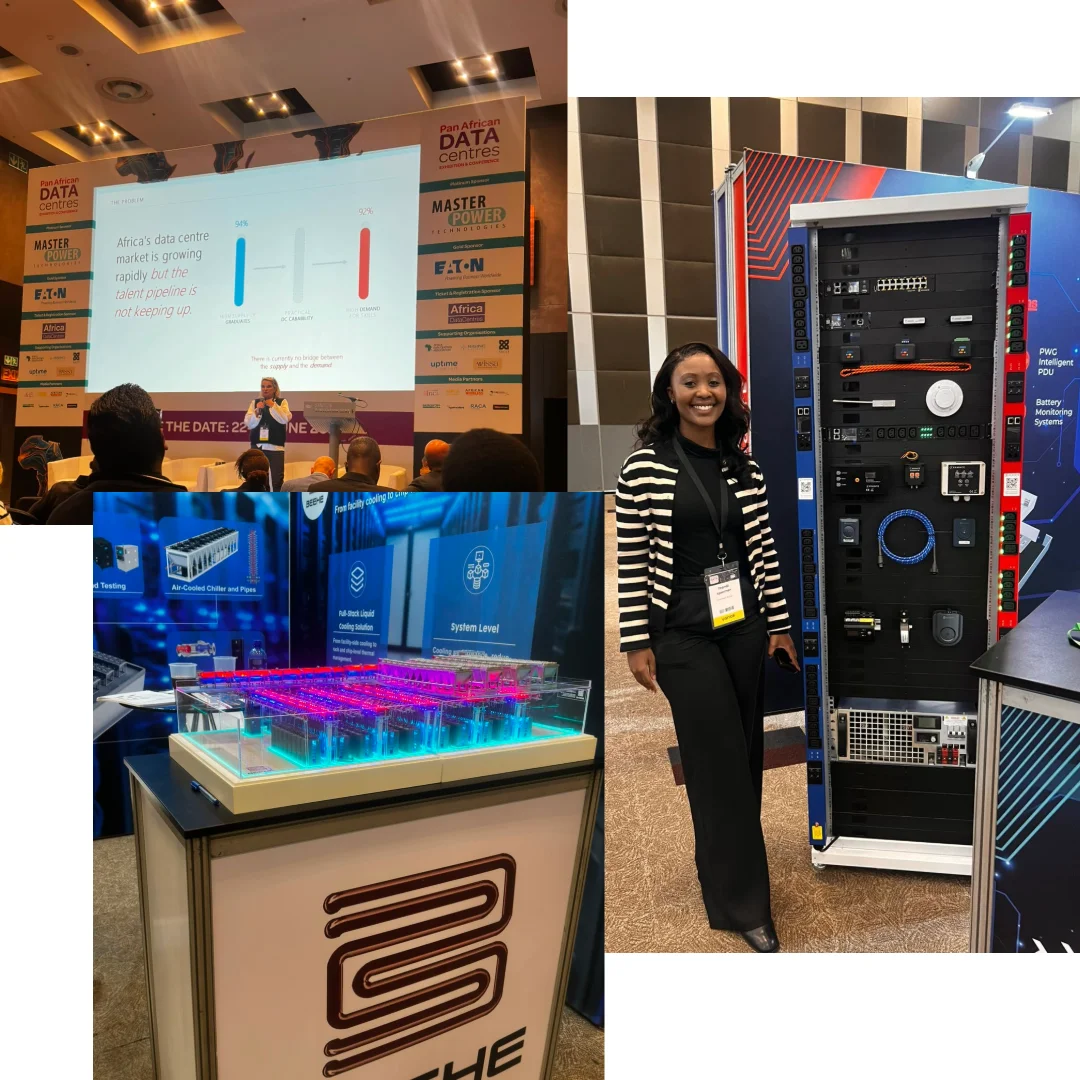 Thandi Speelman at Pan African Data Centre Exhibition 2026
The problem is structural: Africa's data centre industry is growing, yet it faces a severe talent crisis. The market is young, training is limited, and existing recruitment models often lead to poaching and recycling the same limited talent pool. From our own experience placing candidates across the continent, companies are spending months filling critical roles that should take weeks. Operators report difficulty finding competent engineers and technicians who understand the complex interactions required to run a modern facility, with professionals increasingly drawn to opportunities in Europe, the Middle East, and North America.
So what can hiring companies actually do?
The global industry offers a playbook. Microsoft's Datacenter Academy partners directly with community colleges and vocational schools, providing curriculum, hands-on lab equipment, scholarships, and mentorship. This creates a sustainable talent pipeline by empowering local educational institutions to train future generations. AWS mirrors this through its Workforce Accelerator, aligning curricula with employer needs and training faculty in state-of-the-art technology. Microsoft has also opened the programme to career-changers from the military, recognising that discipline and technical aptitude transfer well. Google's STAR Program takes a similar approach, focusing on short-term training and ongoing support to create a direct talent pipeline in the communities where they operate.
The lesson for African operators is clear: stop competing for the same thin pool of experienced candidates and start building your own.
Companies that establish internal training programmes - taking electrical and mechanical engineers from adjacent industries and putting them through structured data centre pathways, will not only solve their own hiring problems but create a competitive advantage in retention. Candidates who are trained and certified by an employer are far more likely to stay. It also positions data centres as an aspirational career destination, not an afterthought. Initiatives like the Africa Data Centre Talent Project, backed by ADCA and led by IBTC, are already moving in this direction - building Africa's first scalable data centre talent pool: sourced, trained, certified, and placed in jobs. The work being done to create new entrants to the market, rather than simply recycling experienced professionals, is exactly what the ecosystem needs. Africa's digital future will be built on infrastructure. But it will be powered by people. The companies that invest in that pipeline now will be the ones best placed to grow.
Source from adjacent industries
One underutilised strategy is looking beyond the data centre industry entirely. Professionals from oil and gas bring deep expertise in critical power systems, high-voltage electrical infrastructure, and mechanical plant operations. Those from utilities and energy have hands-on experience managing power distribution and backup generation - both essential in markets where grid reliability remains a challenge. Manufacturing and heavy engineering produce candidates skilled in facilities management, HVAC, and preventative maintenance. Even the telecoms sector offers a strong pipeline of network engineers and field technicians comfortable working in mission-critical environments. The roles that translate most readily include Electrical Engineers, Mechanical Engineers, Facilities Managers, HVAC Technicians, Power Systems Engineers, and Field Service Technicians. Companies that establish structured pathways to bring these professionals in - pairing them with data centre-specific training and recognised certifications - will not only solve their own hiring problems but create a competitive advantage in retention.
Want to know more about how First Point Group can help with hiring into the data centre market in Africa? Contact Thandi Speelman.